Is my kid doing OK in school?
This simple question should not require a degree in data science. When a mom or dad asks whether their child is on track in reading and math, the answer should be one click away. In Texas, it is not. Key facts are scattered across state portals and long reports built for compliance first and families second.
The result is a maze that protects the system, not the student.
Texas does publish a lot of data. That is good. But it lives in silos. Our A to F ratings sit on one site. The annual Texas Academic Performance Report (TAPR) comes as a lengthy PDF that most people cannot navigate. Finance shows up somewhere else entirely. And for the last five years, school districts have kept suing the state to prevent parents from knowing how they perform.
In short, taxpayers paid for transparency they still cannot use.
That is why I built the Lone Star Ledger at the Texas Public Policy Foundation. It is a public website that puts the essentials first, speaks plain language, and lets parents compare results without downloading spreadsheets or juggling multiple tabs. It is not a new data source. It is a clear window into the state’s own numbers so families can see what is working and what is not.
Consider Dallas ISD. The district earned a B with a score of 83. Yet the district’s own TAPR shows that about half of students are not on grade level in reading, and about 6 in 10 are not on grade level in math. Parents see that and ask a fair question. Does that sound like a B to you? The Lone Star Ledger makes those facts visible in one place, side by side, with links back to the state for verification.
Here is how the Lone Star Ledger serves Texas families and taxpayers.
One place for the basics: You should not have to jump between portals to answer simple questions about reading, math, growth, graduation, and spending. Lone Star Ledger gathers the essentials and links straight back to TXschools, TAPR, and PEIMS so every claim can be checked.
Plain language with context: Ratings matter, but parents also deserve to see the drivers behind a score. The site surfaces the share of students at grade level, whether students are making progress, and other core indicators. It will also flag testing changes that affect year-to-year comparisons, so no one is misled by technical shifts.
Easy comparisons: Texans want to know how a campus stacks up to the district, the region, and the state. The site makes those comparisons straightforward enough for a school board meeting and simple enough for a kitchen table.
Finance next to outcomes: Dollars are tools, not outcomes. Putting spending next to achievement helps communities invest in what works and fix what does not without burying readers in files and codebooks.
Here’s how it looks for Dallas ISD, for example:
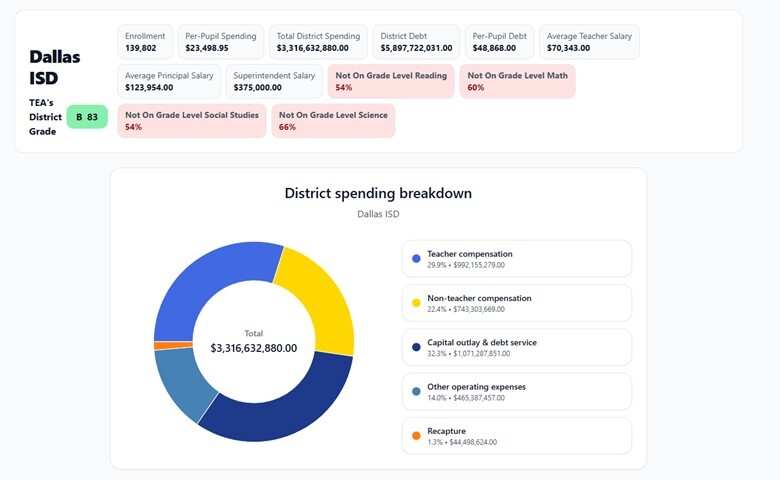
On the district page, you will find key facts about student performance, information about spending, and the accountability score that the state assigned.
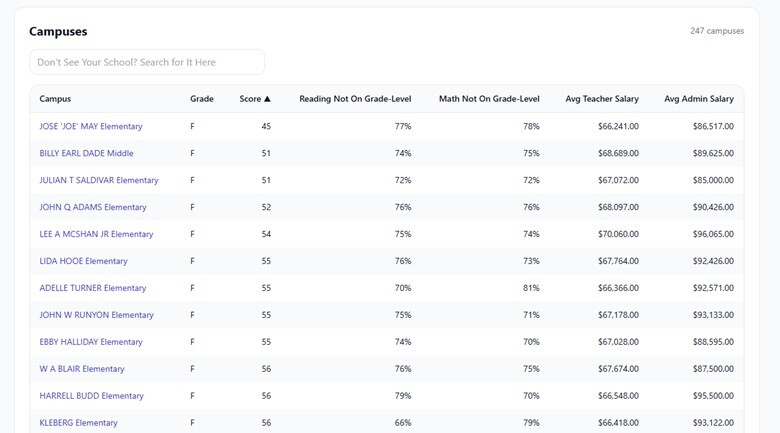
Further down, you will find a list of campuses and each one’s performance on the state STAAR exam and the accountability grade the state gave it.
This is not a hit on teachers. Texas educators work hard. And Texas is more transparent than most states.
But transparency that you cannot use is not real transparency. When official information is spread across multiple portals and file types, families who do not work in education policy are left behind. We can fix that by giving parents a clean, trustworthy picture of results.
Numbers will never replace the judgment of great principals and teachers. But they do show what is possible when adults focus on student mastery and accept responsibility for results. Clear information is not a luxury. It is a duty we owe to Texas families.
The Lone Star Ledger is my contribution to that duty. It is free. It is public. And it exists so parents and taxpayers can see what is happening in their schools without the fog. When parents can see clearly, students win.