Editor’s Note: This is the latest part of a series on rural Texas and the challenges that rural Texans face. Over the next year, the Associated News Service will delve into the issues facing the Lone Star State’s 177 (out of 254) rural counties.
AMARILLO—If you want to fall in love all over again with your hometown, Kashion Smith says, find a job in the tourism industry.
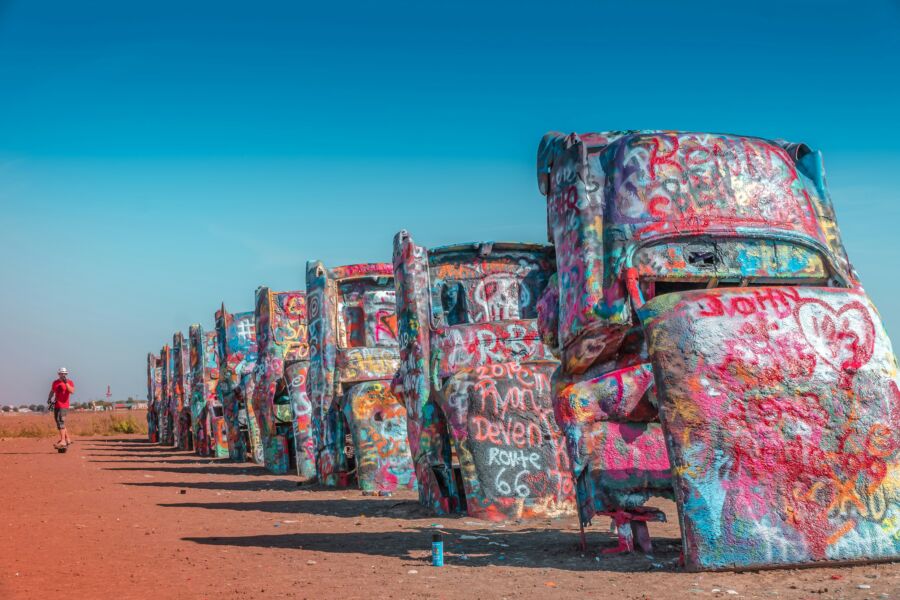
It’s early June, and Amarillo has kicked off its 10-day celebration of Route 66’s centennial anniversary. Smith is at the center of it all, as executive director of Visit Amarillo. She’s overseen much of the planning, but she’ll also be on hand for the car shows, the concerts, the ranch rodeo and the many other events scheduled to celebrate the historic roadway.
“That’s how you fall in love,” she says. “You’ll find yourself interacting with people and small businesses you might not have ever encountered otherwise. You’ll work with everyone in your community—business owners, artists of all kinds. It’s hard to be negative about your hometown when you spend your days telling everyone how wonderful it is.”
Tourism has a big role to play in rural economic development, Smith contends.
“It’s a huge economic driver, but the money is coming from people from outside your community, who aren’t straining your local amenities,” she says. “The dollars they leave behind are incredibly impactful. If you’re mindful of how you are promoting tourism and your town, when you can help provide an experience that parents can share with their children, you are creating a lasting legacy.”
Promoting tourism is about making the most of what you have. Amarillo is fortunate; it has a section of the famous Route 66 going through it, it has a thriving minor league baseball team, and it is steeped in rodeo culture. And on this bright June weekend, it’s celebrating all of those.
The Economic Impact
In 2025, tourism had a $208.1 billion impact on Texas, according to the Texas Travel Alliance.
“Travel and tourism are also a driving factor in the Texas workforce, with more than 1.3 million jobs across the continuum from entry to executive level,” that agency reports.
In direct travel spending, visitors to Texas dropped $98.7 billion in 2025, generating $9.2 billion in state and local taxes.
“A growing travel and tourism industry means more tax dollars to support important public services like education and other community initiatives that benefit local residents,” the Alliance notes.
Tourism is one of the most visible examples of economic development—government leveraging its available resources to attract jobs and business. There are limits to what governments should do, however; more on that later.
Generational
On this June weekend, Amarillo is fast filling up with visitors, most of them families with multiple generations along for the journey.
And tourism must be generational, Smith emphasizes.
“If your hotels aren’t full but your RV parks are, your visitors are probably aging out,” she says.
That’s why it’s so important to program for kids—and kid-friendly events. They’ll come back with their own kids some day, and those tourism dollars will continue to flow.
That’s what drives attendance at Amarillo’s Hodgetown stadium, where the AA minor league team the Sod Poodles (named for the ubiquitous prairie dogs) plays. The beloved Poodles are part of the Arizona Diamondbacks organization, giving ballplayers their shot at the majors. The team used to be the San Antonio Missions, until it was moved to Amarillo for the 2019 season. San Antonio wasn’t left without baseball, however; a new Missions team began play that same year, as part of the San Diego Padres organization.
The Soddies’ first win in Amarillo came on April 6, 2019, when the Sod Poodles beat the Corpus Christi Hooks 7-5, with five runs in the third inning alone.
Tonight, the Sod Poodles have a homestand on the calendar against the Tulsa Drillers, the AA affiliate of the Los Angeles Dodgers. The festivities begin long before the first pitch; there’s a Route 66 car show next to the municipal stadium, along with activities for kids and opportunities to meet players.
Saturday night, in fact, was “Princess and Pirates Night” at Hodgetown, which included a parade around the field before the game.
True, princesses and pirates have very little to do with Route 66, or with the team’s year-long celebration of America’s 250th birthday. And not much to do with baseball. But you know who doesn’t care about that? Kids who get to dress up as princesses and pirates.
The players themselves move around more like young fans than professional athletes—casually walking through the stadium and visiting with families. To be fair, they’re not paid like the celebrities in the big leagues. According to Front Office Sports, the average AA minor league ball player makes about $30,000 per year, or about $1,000 per week.
But it’s clear as players interact with fans, they’re not here for the money. They’re here for the experience. It’s a glorious summer evening and all the world is as bright as a new Rawlings baseball.
Some of these players will make it to the major leagues; remember the team’s first 2019 win against Corpus Christi? The starting pitcher was a young Jesse Scholtens. He pitched two scoreless innings, before allowing two walks. Jesse went on to pitch for the Chicago White Sox, and now plays for the Tampa Bay Rays. His contract for the 2026 season guarantees him $820,000.
But for most players, this is it—their season in the sun. They may or may not get to play next season. Blake Rogers also pitched in that 2019 game, allowing no hits in the fourth and fifth innings. He was able to play for two more years, but ended his professional baseball career with a record of 18 wins, 22 losses and an ERA of 4.71.
The numbers that count for the Sod Poodles, though, are more about economic impact than earned run averages. The team regularly brings in nearly 5,000 fans per night. In 2025, total attendance for the Amarillo Sod Poodles was 319,646, one of the highest totals in the minors.
The Route 66 celebration is helping 2026 outpace last year’s attendance.
“For the month of June, we’re actually expecting about an 18% increase in occupancy with the hotels,” Visit Amarillo’s Kashion Smith told KFDA. “So that equates to, of course, revenue with the hotels, but also with our businesses across town.”
Bigger Questions
But what are the limits to economic development? Particularly for rural regions with limited funds, should government be engaging in development efforts at all?
James Quintero, policy director for the Texas Public Policy Foundation’s Taxpayer Protection Project, says local officials must be careful.
“There are do’s and don’ts for governments wanting to engage in economic development,” Quintero explains.
First and foremost, government needs to get out of the way of what’s already happening organically. When government is limited, an economy’s potential is limitless.
“The right way involves restraining government and ensuring that market actors are free to create and compete within a lawful, well-defined structure,” Quintero notes. “Oftentimes this requires intentional policymaking with an eye toward less government regulation, reduced public expenditures, and a minimal tax burden.”
There’s also a wrong way, he adds.
“The wrong way emphasizes the role of central planners and relies heavily on the use of public subsidies, incentives, and hand-outs,” Quintero says. “In such a system, local policymakers direct targeted benefits to well-connected firms with ample political and financial capital, usually at the expense of established competitors, entrepreneurs, and the everyman.”
Cities taxing residents to fund a big giveaway—say a new stadium—is an example of doing it wrong. Nashville, for example, is building a new $2.1 billion stadium for the Tennessee Titans. It relies heavily on public funding—tax dollars.
According to the New York Times, “The city’s likely approval of $760 million in revenue bonds, combined with $500 million already approved by the state, brings the total public contribution for the stadium to $1.26 billion, far and away the biggest sports subsidy in U.S. history by nearly 50 percent.”
One Nashville City Council member has opposed spending tax dollars to benefit a private business.
“It is still shocking to me that in a state with no income tax, a state that prides itself on being low-tax, and we’ve got a specialty plate— ‘Don’t tread on me’—and somehow we’re going to end up having the biggest public spend on a stadium in the history of America,” councilman Bob Mendes told the NYT. “It’s weird.”
Supporters of public expenditures like stadiums often point to hotel occupancy tax (HOT) revenues as fiscal justification. Visitors to Tennessee Titans games need somewhere to stay, they reason, and besides, it’s mostly visitors who pay those taxes. But does the math add up?
It doesn’t—usually.
“Consumption taxes, like the HOT, are not unreasonable in the abstract. But Texas’ hotel tax has been configured poorly and unproductively, making it practically indefensible. Because of this, Texans would be better off if policymakers eliminated it entirely,” says TPPF’s Quintero.
That’s not a popular position at the Capitol, however, and Quintero acknowledges that the perfect shouldn’t become the enemy of the good.
“In the absence of elimination, the Foundation has developed a set of incremental reforms that can be implemented at the state or local level, wherever there is sufficient political will,” Quintero says.
Those reforms include:
- Requiring regular audits of those organizations receiving local HOT revenues to determine use and return on investment.
- Link audit reports’ results with the renewing of grants funded through HOT revenues. Make these reports publicly available online.
- Eliminate or significantly reduce grants that fail to generate increased tourism, and decrease the local HOT rates accordingly.
A TPPF report notes that “Texas’ main cities have some of the highest hotel occupancy taxes in the nation and this additional cost to visitors could hurt the state’s ability to compete with other popular destinations. Surveys have found that the price of accommodations represents one of the most influential factors in travelers’ booking decisions. Instead of acting as a boon to local economic development, the combination of state and local hotel occupancy taxes—a large part of the revenues are used to promote tourism—may actually end up deterring visitors from staying in Texas hotels and patronizing Texas businesses.”
Still, tourism is an undeniable boon for rural Texas. The key is allowing it to happen organically.
“Some rural governments are tempted to build or become the public attraction instead of fostering the environment in which entrepreneurs, small businesses, and communities can organize and thrive organically,” Quintero says. “In so doing, these governments stymie their own communities’ long-term growth potential by siphoning away finite resources from a small, productive few to use in questionable ways.”
What does this look like on the ground?
“Stakeholders seeking to boost rural tourism can do so by encouraging entrepreneurship, easing small business formation, ensuring adequate public infrastructure, and enabling market actors to leverage local assets with minimal hassle,” Quintero says.
When Amarillo invites the world to share what it already is—rather than what some planner thinks it ought to become—it demonstrates the truth of the moral and political principles that made Texas, and America, possible in the first place.
Amarillo By Morning
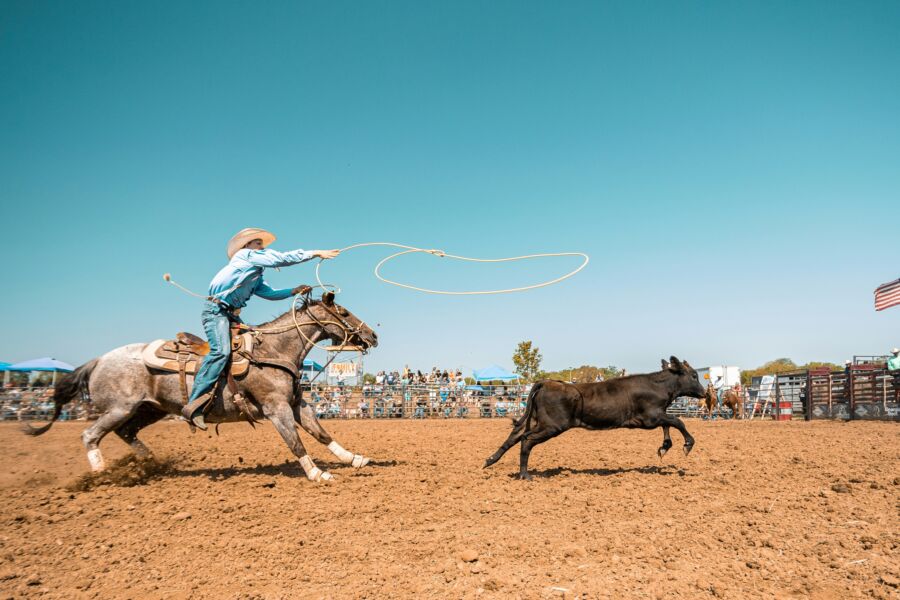
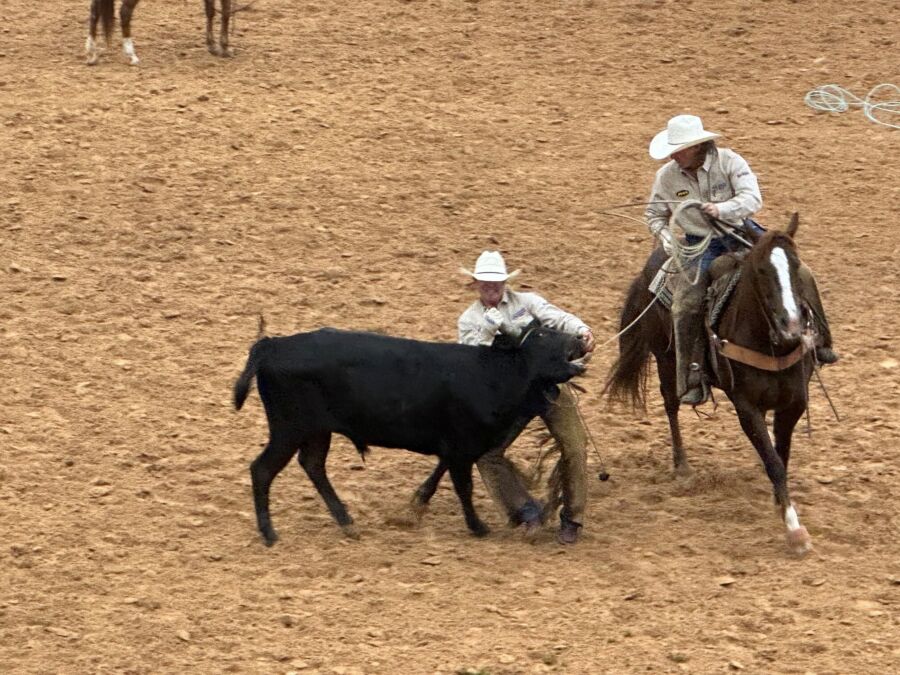
Amarillo’s Coors Cowboy Club Ranch Rodeo was also a highlight of the city’s Route 66 celebration. Ranch rodeos aren’t like the pro series; they’re made up of teams of working cowboys, many from nearby ranches. The crowd favorite in Friday night’s events was clearly the 6666 Ranch team, from the Guthrie, Texas ranch established in 1870. Now controlled by an ownership group that includes Taylor Sheridan, the Four Sixes Ranch encompasses more than 350,000 acres of land.
The Friday night rodeo at the Tri-State Fairgrounds is close to sold-out, though it seems there are nearly as many cowboys competing as there are in the stands. They compete in some familiar events—bronc-busting, for example, and team roping. They also compete in wild cow milking and team branding.
“Unlike many rodeos, ranch rodeos highlight the real-world skills cowboys use every day on working ranches,” the Coors Cowboy Club explains. “From the arena to the final results, the events reflect the challenges, teamwork, and horsemanship that define ranch life.”
The event itself is awash in unapologetic patriotism—America’s 250th anniversary was marked, as was the passing of former rodeo cowboy Larry Dawson, who was drafted by the Dallas Cowboys in 1961, but chose to pursue rodeo instead of football. He was later a rodeo flag judge and a rancher.
Dawson’s funeral, in true cowboy fashion, was held in that same arena, just a few months before.
These small remembrances matter, especially at a time when it’s fashionable to kneel during or to outright ignore the national anthem. Reverence for the past isn’t weakness.
What’s unique about the Coors Club Ranch Rodeo is that it celebrates what Amarillo already has—a deep and abiding cowboy culture. Nothing was manufactured, and there was no element of “if you build it, they will come.” Instead, it capitalizes on regional strengths.
“It’s really about empowering individuals, cultivating the right environment, and then getting out of the way,” says TPPF’s Quintero. “It’s critical local government officials recognize that the private sector is best positioned to create jobs and wealth, not the public sector.”
Public officials can do much to encourage economic development—without dipping into the treasury.
“Instead, their role is to ensure that the rule of law, public confidence, appropriate infrastructure, and sensible policy exists in abundance,” Quintero says. “With those things intact, it’s then incumbent on local officials to remove themselves from the equation and permit market actors to go about pursuing productive activities without state interference.”
Visit Amarillo’s Kashion Smith was at that Friday night rodeo, just as a fan.
“My favorite part is that kids get to see kid cowboys,” she says. “At age 4, boy or girl, you can be a cowboy.”
It might be mutton-busting, or even just wearing a hat on a parade float, but the Ranch Rodeo is an intensely participatory event.
“When people come to Texas, they want cowboys,” Smith says. “And we have that. We might not have the glitzy things that the big cities do, but that works to our advantage. Small towns, and their slower pace, are what travelers are looking for lately. They want people who look them in the eye. They want cooks in the diners to come talk to them at the table. They want touchpoints and true human interaction.”
The cowboys competing, the fans cheering the Sod Poodles, the visitors making their own ways down Route 66—these aren’t just local color or economic assets. They’re manifestations of a people still free in their pursuit of happiness under a government that exists to secure God-given rights, not to manufacture them.
Authenticity is something rural Texas can provide—and always has. In 1836, while in Nacogdoches on his way to the Alamo, Davy Crockett wrote to his family of what he had seen so far of Texas.
“It is the garden spot of the world,” he wrote. “The best land and the best prospect for health I ever saw is here, and I do believe it is a fortune to any man to come here.”