Housing prices in Texas remain elevated despite recent reforms in part due to variations in municipal code enforcement. Local amendments and provisions made by municipalities exacerbate these differences.
- Building and technical code upgrades can increase construction costs, resulting in higher home prices for prospective homeowners and businesses.
- Building and technical code regulations are convoluted, making it difficult for builders to navigate.
- Local provisions and amendments can further complicate the environment for builders and increase construction costs.
The 90th Texas Legislature should consider establishing a statewide building and technical code standard for single-family homes.
Click here to download the full paper
Executive Summary
Housing prices in the Texas market remain elevated despite recent legislative reforms.1 One reason is that state and local governments can increase construction costs through periodic updates and amendments to building and technical code standards. This ever-changing environment creates direct costs (i.e., paying for new and different add-ons) as well as indirect costs (i.e., navigating regulatory inconsistency and complexity at the local level). It is difficult to fully measure the extent to which building and technical codes contribute to housing costs statewide due to variation across municipalities; however, some estimates show that incremental model code upgrades and sudden municipal adaptations can put meaningful upward pressure on the costs for builders, homeowners, and those in the market looking to purchase a home. To create a friendlier environment for builders and to ensure model code upgrades provide clear benefits to a home, the 90th Texas Legislature should consider establishing a statewide code standard for single-family homes.
Housing Prices in Texas
Despite recent market corrections, housing affordability remains a serious challenge in Texas. The state’s housing market experienced an unprecedented boom this past decade, spurred by rapid migration, low interest rates, and other economic variables, including a growing job market. Consequently, the median housing price jumped from $195,500 in 2015 to $340,000 in 2022, an increase of $144,500 or 73.9%.2 The housing market has since stabilized, with the median price dropping by $5,000 or 1.5% between 2022 and 2025 (TRERC, n.d.). Statewide trends are consistent with the four most populated Metropolitan Statistical Areas (MSAs).
The four largest MSAs in Texas each experienced substantial increases in housing prices between 2015 and 2022. Austin-Round Rock-San Marcos experienced the steepest rise during this period. The median housing price in Austin-Round Rock-San Marcos rose from $260,000 in 2015 to $502,000 in 2022, an increase of 93.1% (TRERC, n.d.). Dallas-Fort Worth-Arlington experienced the second-highest growth rate, with prices up by 87.1%, followed by San Antonio-New Braunfels (+68.4%) and Houston-Pasadena-The Woodlands (+59.5%) (TRERC, n.d.). Other than Austin-Round Rock-San Marcos’ steep 10.4% drop in 2023, prices began to level out in 2022, preserving elevated housing prices up to the present day (see Table 1).
Table 1
Median Housing Prices Across Texas (2015-2025)
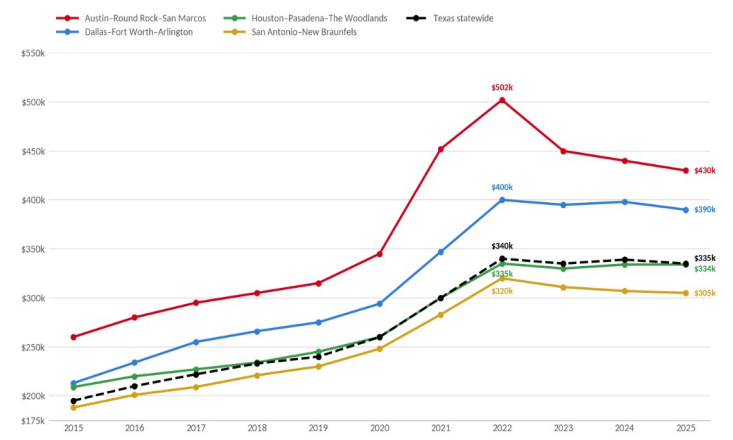
Note. Data from Texas Real Estate Center and author’s calculations.
Price stabilization may offer some immediate relief, but it is not necessarily an enduring sign of affordable housing, especially if the new equilibrium emerged following an unprecedented boom. Take, for instance, that nearly a quarter of owner-occupied households in Texas were “cost-burdened” in 2024 (U.S. Census Bureau, 2024), a term used to define people who spend “at least 30 percent of their income” on housing (Green, 2024, para. 9). The cost-burden distribution varies widely depending on household income, with 83% of owner-occupied housing units with incomes of $20,000 or less being cost-burdened, and 11% of households making $75,000 or more being cost-burdened (U.S. Census Bureau, 2024).
To ease these burdens, state and local government elected officials should scale back on the litany of fiscal and regulatory pressures contributing to the elevated price environment. These include costs created by building and technical code adaptations.
Building and Technical Codes
Building and technical codes in Texas and across the United States are largely based on model codes from the International Code Council (ICC). The ICC, which is a Washington-based non-profit, establishes “minimum safeguards” (ICC, n.d.-a) that it claims ensure “safe, affordable, and sustainable buildings and communities” worldwide (ICC, n.d.-b). Despite its stated mission, there are reasons to be skeptical of its affordability claim.
Looking specifically at the impact building and technical codes have on single-family homes, an analysis from the Department of Energy (2026) estimates that enforcing the 2024 International Energy Conservation Code (IECC) could increase construction costs in Texas by $8,337 when compared to the 2006 version. Furthermore, the Home Innovation Research Lab (2025), when using Houston as a geographic proxy, estimates that complying with the 2024 IECC, relative to the 2018 IECC, could increase cost to the consumer by $3,129 for single-family gas homes and $2,391 for single-family electric homes. Increases in upfront costs are ultimately passed on to homebuyers; however, renters can also be negatively affected by higher upfront costs. Eriksen, Besiktepe, and Martani (2025) note that, between 2012 and 2021, the International Building Code (IBC) underwent 22 revisions that would have increased construction costs for their prototype apartment building by 12.4%, resulting in a $169 to $279 increase in monthly break-even rent for 2-bedroom units in new developments.
Building and Technical Code Environment in Texas
In Texas, building and technical code standards are complex and convoluted. This is largely due to Texas operating under a hybrid system that combines state baselines with local adaptations and amendments. This system, in theory, allows cities to improve statewide baselines to suit local conditions. However, this dynamic creates inconsistencies and inefficiencies in regulatory standards, even among neighboring cities with near-identical conditions.
Rasor (2025) observed in 2025 that Austin, Pflugerville, and Manor, which are all within Travis County and separated by less than 20 miles, “operate in completely different regulatory worlds.” Austin generally adopts the most recent model codes published by the ICC (City of Austin, n.d.-a). Pflugerville, by contrast, currently uses the 2021 ICC codes (City of Pflugerville, n.d.), putting it three years behind Austin, while Manor currently uses the 2015 ICC codes (City of Manor, n.d.), putting it nine years behind Austin and six years behind Pflugerville. These differences between neighboring cities force builders to comply with various rules and regulations, leading to changes in “design requirements, material costs, labor needs, and project timelines” (Rasor, 2025). Additionally, municipalities can further complicate the situation by adopting local provisions. This means that builders must not only contend with the differences between ICC code editions to build in various cities, but also must be prepared to adapt to local changes. While local provisions are not uncommon, not every change produces a clear and obvious benefit. In fact, some appear to be discriminatory while also increasing costs for builders and consumers.
For example, the City of Austin adopted electric-ready infrastructure requirements for certain new residential and commercial buildings (City of Austin, n.d.). This change was in furtherance of Austin’s Climate Equity Plan (City of Austin, 2024), which proposes numerous quixotic environmental goals such as “equitably reaching net-zero community-wide greenhouse gas emissions by 2040 with a strong emphasis on cutting emissions by 2030” (City of Austin, n.d.-c). While Austin’s electrification goals may align with its climate change aspirations, it likely violates Subsection 181.903(b) of the Utility Code, which reads:
No regulatory authority, planning authority, or political subdivision of this state may adopt or enforce an ordinance, resolution, regulation, code, order, policy, or other measure that has the purpose, intent, or effect of directly or indirectly banning, limiting, restricting, discriminating against, or prohibiting the connection or reconnection of a utility service or the construction, maintenance, or installation of residential, commercial, or other public or private infrastructure for a utility service based on the type or source of energy to be delivered to the end-use customer. (Tex. Util. Code § 181.903(b), p. 1013)
In a nonbinding legal opinion, Attorney General Ken Paxton claimed that the city’s commercial provision “has the ‘purpose, intent, or effect of directly or indirectly’ discriminating against natural gas utility services” (Attorney General of Texas, 2026). Similarly, Texas Gas Service stated that Austin’s electric-ready provisions “for both commercial and residential end-uses” may violate Tex. Util. Code § 181.903 (City of Austin, 2025, p. 10). For its part, Austin officials argue that its electric-ready provisions have both an optionality and affordability aspect to them, stating that they provide “current and future property owners an affordable pathway to choose efficient electric technologies and eliminate polluting fossil fuel use for transportation and use in the home” (City of Austin, 2024). However, there are currently no laws that prohibit homeowners from electrifying their homes, and arguments in favor of the provisions’ cost-effectiveness rely on certain far-fetched assumptions.
Consider that, as noted by Texas Gas Service, the perceived benefits of electric-ready infrastructure operate under the assumption that property owners will, or are likely to, replace their current energy source with “electric alternatives” (City of Austin, 2025, p. 8). Even when taking into account the reduced cost of retrofitting a home, there are legitimate reasons to question that assumption given that (i) there is still an upfront cost for electrification, and (ii) using natural gas tends to be cheaper than electricity. A DOE analysis (2024) found that electricity costs were 3.5 times higher than natural gas per unit of energy (see Figure 1). Furthermore, Austin’s electric-ready provisions likely increase construction costs, with one estimate showing that electric-ready infrastructure for new single-family homes increases upfront cost by up to $1,800, which is “equivalent to the expense of upgrading to an average stone kitchen countertop” (Denniston, Burk, Beddingfield, & Cheslak, 2022, p. 4).
Figure 1
Residential Energy Costs
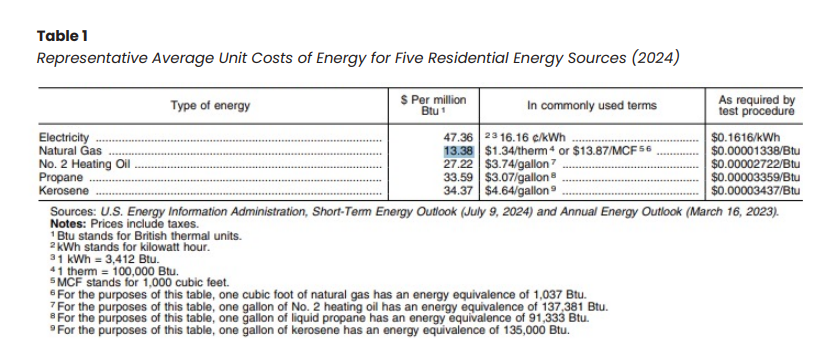
Note. Image obtained from the Federal Register Vol. 89, No. 201 (U.S. Department of Energy, 2024, p. 83673).
In addition to building and technical codes, builders must also contend with other forms of regulatory burdens. The City of Lockhart (n.d.), for instance, requires single-family dwellings to provide covered parking for at least one vehicle, either in the form of a carport or garage. The City of Murphy (n.d.) takes it a step further and requires new single-family homes to include an “attached and enclosed garage for all required off-street parking.” These mandates also increase construction costs without providing a clear and obvious benefit. Consider that Murphy’s requirement appears in the city’s parking provisions, yet many homeowners do not use their garages to park vehicles, with one survey indicating that 36% of Americans do not have the space to park their vehicle inside the garage due to it being too cluttered (Craftsman, 2022). Estimates vary, but the average added cost of building an attached garage in Lockhart exceeds $25,000 (StudioBuilt, 2026).
Indeed, these types of code amendments create unnecessary new costs for consumers and complications for builders, as they are forced to comply with a multitude of mandates in an already discombobulated climate.
Policy Recommendations
In Texas, building and technical codes can vary widely due to the lack of local regulatory consistency, making it difficult for developers to construct efficiently, consumers to purchase inexpensively, and policymakers to assess the environment accurately. While it is difficult to know with certainty how much this inconsistency contributes to the broader affordability problem, national and other official analyses show that housing prices are generally pushed upward by the adoption of new and stringent building and technical codes.
In light of this concern, the 90th Texas Legislature should enact legislation to promote uniformity and transparency in building and technical code standards, much like 2023’s Texas Regulatory Consistency Act (HB 2127, 2023) sought to improve the local regulatory environment.3 In so doing, policymakers can cultivate a more predictable system for builders and a more affordable climate for consumers.
To accomplish this goal, the Legislature should consider the following mechanisms:
- Establish a Statewide Building and Technical Code Standard for Single-Family Homes: Given the concerns with the ICC, the Legislature should task the appropriate agency to develop a Texas-First statewide code standard for single-family homes. The statewide code should establish geographic regions and modify it to meet regional needs. The Legislature should also draw from the experience of other states, like Florida, that currently have “a single statewide code based on national model codes and consensus standards, amended for [its] specific needs for the design and construction of buildings” (Florida Department of Business & Professional Regulation, n.d.). In Florida’s case, this single statewide standard “replaced [the state’s] patchwork of codes and regulations that were developed, amended, administered and enforced by more than 400 local jurisdictions and state agencies with building code regulation responsibilities” (Florida Department of Business & Professional Regulation, n.d.). By enacting such a change, policymakers might create predictability for builders, address time management concerns, and lessen the impact of technical codes on total construction costs over time.
- Study Establishing a Statewide Building and Technical Code Standard: The Legislature should task an R1 institution to conduct a feasibility study examining the extent to which a statewide building and technical code would positively contribute to improving the environment for builders, consumers, and the real estate community.
- Require Regulatory Impact Analyses at the Local Level: Require cities to estimate and make publicly available potential cost increases when changing or updating code standards. Any such analysis should include direct and indirect cost assessments detailing the extent to which building and technical code changes may contribute to construction costs, time delays, and home price increases. Policymakers should require that this information be made available for public consumption before the local governing body takes any official action.
References
Attorney General of Texas. (2026, June 26). Opinion No. KP-0521: Whether the City of Austin’s proposed energy code conflicts with Texas Utilities Code § 181.903 (RQ-0600-KP). https://www.texasattorneygeneral.gov/sites/default/files/opinion-files/opinion/2026/kp-0521.pdf
City of Austin. (2025, April 10). 2024 Technical Code Engagement Question/Comment Summary. https://services.austintexas.gov/edims/document.cfm?id=448384&
City of Austin. (2024, September 25). Joint Sustainability Committee recommendation 20240925-007. https://services.austintexas.gov/edims/document.cfm?id=437661&
City of Austin. (n.d.-a). Building technical codes. Retrieved July 16, 2026, from https://www.austintexas.gov/development-services/building-technical-codes
City of Austin. (n.d.-b). 2024 International Energy Conservation Code amendments. Retrieved October 28, 2026, from https://services.austintexas.gov/edims/document.cfm?id=452785
City of Austin Climate Action and Resilience. (n.d.-c). Austin Climate Equity Plan. Retrieved July 16, 2026, from https://www.austintexas.gov/climate/austin-climate-equity-plan
City of Lockhart. (n.d.). Zoning Districts and Standards. Retrieved October 16, 2026, from https://library.municode.com/tx/lockhart/codes/code_of_ordinances?nodeId=PTIICOOR_CH64ZO_ARTVIIZODIST_S64-197RECOALSEDI
City of Manor. (n.d.). Technical and Construction Codes and Standards. Retrieved July 16, 2026, from https://library.municode.com/tx/manor/codes/code_of_ordinances?nodeId=COOR_CH3BURE_ART3.03TECOCOST_DIV2BUCORECO
City of Murphy. (n.d.). Buildings and Development. Retrieved October 16, 2026, from https://ecode360.com/39771055
City of Pflugerville. (n.d.). City Construction Code. Retrieved July 16, 2026, from https://ecode360.com/39355333
Craftsman (2022, November 1). Take Back Your Garage: American Garages Store More Clutter Than Cars, According to Craftsman Survey. https://press.craftsman.com/2022-11-1-Take-Back-Your-Garage-American-Garages-Store-More-Clutter-Than-Cars,-According-to-CRAFTSMAN-R-Survey
Denniston, S., Burk, D., Beddingfield, E., & Cheslak, K. (2022, April 10). Cost Study of the Building Decarbonization Code. New Buildings Institute. https://web.archive.org/web/20230112143052/https:/newbuildings.org/wp-content/uploads/2022/04/BuildingDecarbCostStudy.pdf
Eriksen, M. D., Besiktepe, D., & Martani, C. (2025). The Effect of 2012–2021 Building Code Revisions on Break-Even Rents of 3-Story Apartments. ResearchGate. https://doi.org/10.2139/ssrn.5984894
Florida Department of Business & Professional Regulation. (n.d.). Building codes and standards. Retrieved July 21, 2026, from https://www2.myfloridalicense.com/building-codes-and-standards/
Green, D. (2024, October). Housing affordability gap hits Texas: Comptroller’s report cites housing shortage. Texas Comptroller of Public Accounts. https://comptroller.texas.gov/economy/fiscal-notes/economics/2024/aff-housing/
HB 2127. Enrolled. 88th Texas Legislature. Regular. (2023). https://capitol.texas.gov/tlodocs/88R/billtext/pdf/HB02127F.pdf
Home Innovation Research Labs. (2025, January 13). 2024 IECC cost analysis for single-family homes. National Association of Home Builders. https://www.nahb.org/-/media/NAHB/advocacy/docs/top-priorities/codes/code-adoption/2024-iecc-cost-analysis-hirl.pdf
International Code Council (ICC). (n.d.-a). International Code Council fact sheet. Retrieved July 16, 2026, from https://www.iccsafe.org/wp-content/uploads/fact-sheet.pdf
International Code Council (ICC). (n.d.-b). Who we are. Retrieved July 16, 2026, from https://www.iccsafe.org/about/who-we-are/
Rasor, R. (2025, October 21). The home rule problem: Why three Texas cities 20 miles apart operate in different code worlds. Fordje. https://www.fordje.com/blog/home-rule-problem-texas-cities
StudioBuilt (2026). Verse-Attached-Garage-Cost-Breakdown-10.8.2026. https://www.texaspolicy.com/wp-content/uploads/2026/10/Verse-Attached-Garage-Cost-Breakdown-10.8.2026.csv
Texas Real Estate Research Center (TRERC). (n.d.). Housing activity: Texas. Texas A&M University. Retrieved July 16, 2026, from https://trerc.tamu.edu/data/housing-activity/?data-State=Texas
Texas Utilities Code § 181.903. https://tcss.legis.texas.gov/resources/sdocs/utilitiescode.pdf
U.S. Census Bureau. (2024). Financial characteristics (ACSST1Y2024.S2503), American Community Survey 1-year estimates. https://data.census.gov/table/ACSST1Y2024.S2503?g=040XX00US48
U.S. Department of Energy (DOE). (2026). Impacts of Residential Building Energy Codes. https://www.energycodes.gov/impacts
U.S. Department of Energy (DOE). (2024, October 17). Energy Conservation Program for Consumer Products: Representative Average Unit Costs of Energy. https://www.govinfo.gov/content/pkg/FR-2024-10-17/pdf/FR-2024-10-17.pdf