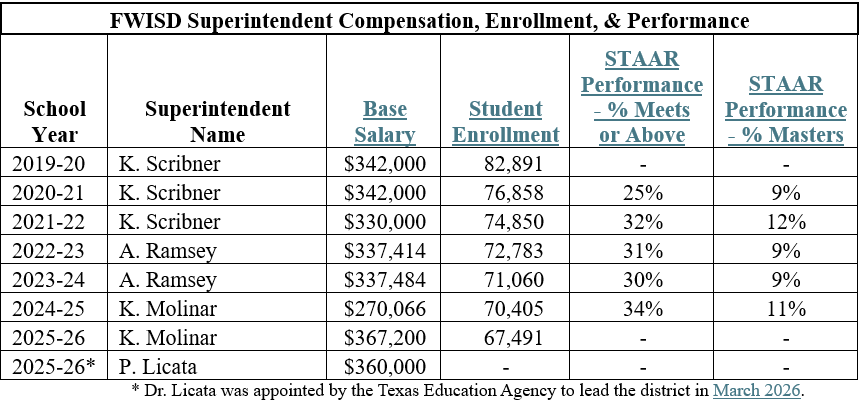
In October 2025, Texas Education Agency Commissioner Mike Morath notified Fort Worth ISD (FWISD) trustees and administrators that “chronically low levels of support given to students and very low levels of academic performance” had prompted a state takeover of district operations. In support of the intervention, officials provided ample evidence of the obvious problems, like the fact that, in the 2024-25 school year, the percentage of students able to read, write, and do math at or above grade level was just 34%.
While the state’s move to protect Texas schoolchildren did not come as a surprise, one recent development has caught some observers off guard. That is, the lavishness of the new superintendent’s compensation package.
Thanks to the generosity of Texas taxpayers, FWISD’s latest top administrator, Dr. Peter Licata, is set to receive a base salary of $360,000 per year, which is only a few thousand dollars less than the previous superintendent’s high mark (i.e., $367,200/annually). At this level, Licata’s pay rivals that of the President of the United States (i.e., $400,000) and more than doubles the Texas Governor’s (i.e., $153,750).
And, of course, that’s just the salary portion.
As noted by the Fort Worth Star-Telegram:
“In addition to the base salary, Licata will receive a $1,000 car allowance. The school district will also pay the medical insurance premiums for Licata and any of his family members who qualify for coverage. Beginning July 1, 2027, Licata will receive ‘an increase in salary equal to the highest percentage raise given to the District’s teachers,’ according to the contract. Licata will also receive $300 a month to pay for personal communication devices. The district will also reimburse Licata for the cost of the annual premium of a life insurance policy.”
The combined value of all these many benefits is difficult to determine, but if history is any guide, then it could be worth an added 15% – 20%. Consider that, before being dismissed for dismal student performance, then-FWISD superintendent Karen Molinar’s total pay was estimated at $430,065 for the 2025-26 school year. Of that amount, $367,200 came in the form of straight salary while the remainder, or $62,865, came as other benefits.
To better understand how these colossal compensation amounts compare locally, the average FWISD teacher salary was $69,118 in 2024-25, the median household income in Ft. Worth was $79,507 in 2024, and the per capita income for the larger Dallas-Fort Worth-Arlington area was $74,066 in 2025.
There’s another bothersome element about Licata’s pay package too. That is, it appears to be the continuation of a practice wherein an elite few are paid huge sums despite worsening circumstances.
Consider student enrollment trends since COVID. From 2019-20 to 2025-26, the number of students enrolled at FWISD dropped from 82,891 to 67,491. That’s a decline of more than 15,000 students or nearly 20% in a relatively short period, signaling obvious discontent among parents and students, which seemingly made no difference on the compensation side of things.
Of course, that sentiment was likely rooted in concerns over student outcomes.
For several years now, FWISD’s academic performance, as measured by the STAAR test, have been substandard, to say the least. As previously mentioned, the percentage of students able to read, write, and do math at or above grade level was just 34% in 2025-25 whereas the percentage of students demonstrating mastery was only 11%. Shockingly, those low levels are actually an improvement over the 2020-21 school year’s results—the latest available online—wherein the percentage of students learning at or above grade level was 25% and those demonstrating mastery totaled 9%.
It’s against this troubling backdrop that, time-and-again, FWISD appears ready to hand over top dollar to an elite few whilst forcing everyone else to cover the cost through higher property taxes.
Situations like this should concern not only Ft. Worth-area taxpayers, but also every Texas taxpayer since more than 40% of FWISD’s latest adopted budget is funded through state appropriations. This type of misappropriation isn’t just bad for taxpayers though, it’s also harmful to students since every dollar that goes to a fat cat administrator is one less dollar available for the classroom. And that’s where our resources are needed most.
Looking ahead, it may be time for the Texas Legislature to establish some reasonable guardrails around local public executive compensation packages, for both the protection of Texas taxpayers as well as to ensure that resources are going to where they’re needed most—and not for the enrichment of any one particular individual or an elite few.