More than 700 Islamic nonprofit organizations operate across Texas. An ideological survey and mapping of these groups indicates that at least a third operate under the influence or control of one of seven terror-tied Islamist networks active in the state.
Movements such as the Taliban-tied Deobandis, anti-Semitic Salafis, and the violent Jamaat-e-Islami movement, among others, have used this nonprofit infrastructure to accumulate and develop significant wealth in Texas. Now, they hope to turn that wealth into influence on the street and in the halls of power.
Gauging Texas Islamist Wealth
Just 232 of Texas Islam’s 700 organizations have filed a tax return. And yet the most recent tax return filings for just this subset indicate over $544 million in annual revenue and almost $400 million of assets.
Of those that file a return, Islamist movements control almost two-thirds of the annually reported assets.
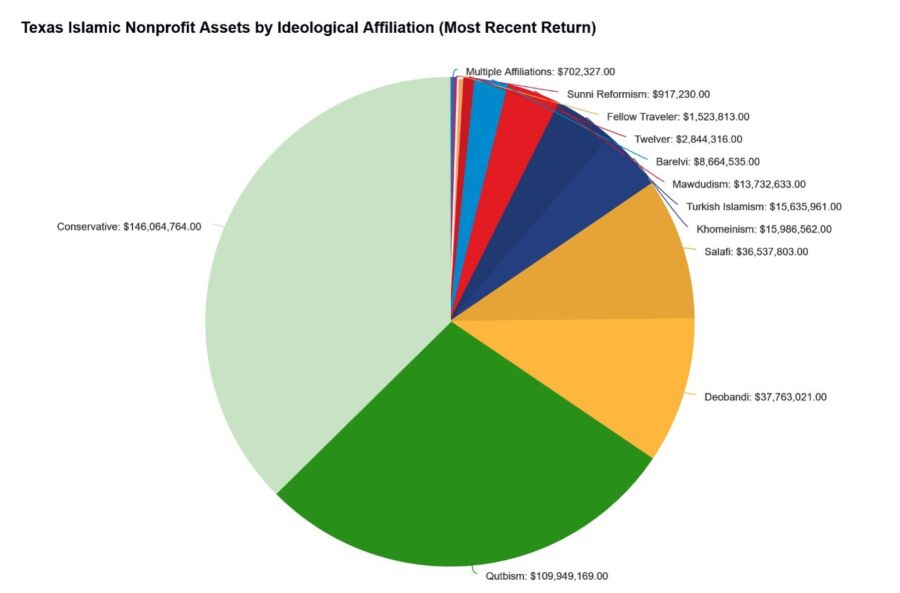
The remaining groups do not file nonprofit returns. Some operate without a registered nonprofit 501(c) status; some raise money through a fiscal sponsor or parent organization; some do not meet the revenue threshold to file; and many make extensive use of the filing exemption the IRS grants to churches and certain church-affiliated organizations and activities.
However, even groups that do not file occasionally appear in IRS data. The nonprofit tax return system discloses grants moving through the 501(c) system by both public charities and private foundations. A review of this data reveals some $250 million of grants issued by either national Islamic organizations to Texas beneficiaries or Texas Islamic organizations to national beneficiaries, spread across some 9,000 transactions over the past decade.
Notwithstanding, it is difficult to estimate the true scale of Texas Islamist revenue. All we know is that it is significantly more than we know.
Other data sources do offer additional—if oblique—indications. For instance, many of the Texas mosques that do not file returns have registered architectural projects with the state government.
Since 2009, almost a quarter billion dollars of planned or completed mosque building costs have been registered with the Texas Department of Licensing and Regulation’s Architectural Barriers Projects database.
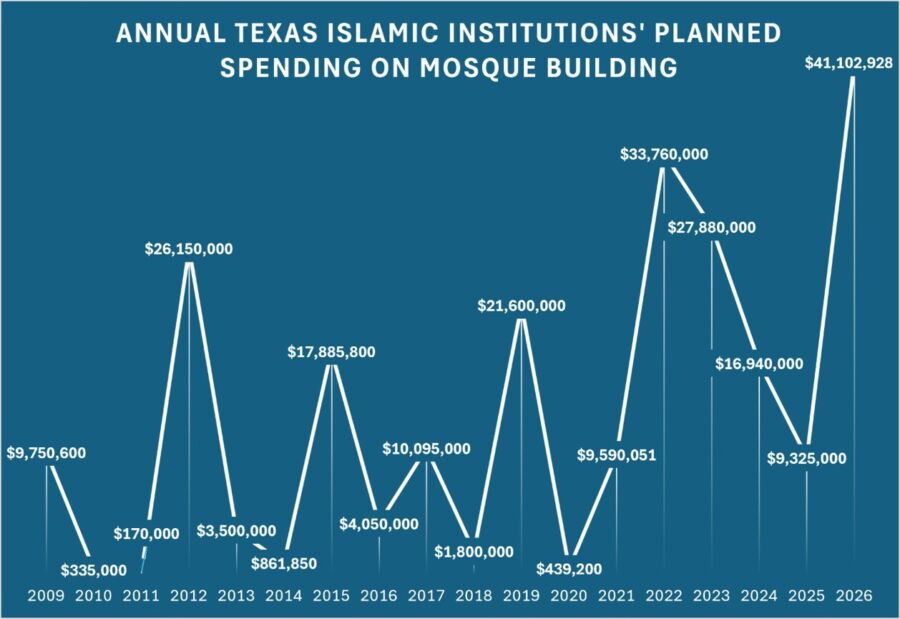
The most recent project under review by the department is a $30 million plan by the Nueces Mosque, a student-founded institution whose current imams belong to the radical Deobandi sect, to build a 75,000 square-foot “mosque & residential tower with prayer hall, community center, administrative offices, cafe, classrooms and study spaces; as well as 4 stories of residential apartments (36 units/92 residents) and support spaces.”
The lead cleric, Anwer Imam, trained at a Deobandi madrassa in North Texas named the Qalam Institute, where he studied under Qalam’s founders, Hussain Kamani and Abdul Nasir Jangda. Western society, Kamani declares, is “filth. … We are surrounded by filth … our environment is full of this filth, everywhere we turn.” Kamani and Jangda have also justified sex slavery and sanctioned the killing of adulterers.
Just a few years ago, the Qalam Institute found the funds to move into a nine-acre campus with a 43,000 square-foot building. Each year, this wealthy DFW institution trains hundreds of new imams and preachers, now “serving communities across the country.”
None of these disclosed funding amounts, however, includes the considerable monies moved around outside the 501(c) system. A growing sharia finance industry operates across the state, mostly incorporated as for-profit institutions, wielding many tens of millions of additional dollars.
Moreover, wealthy, middle-class Texas Muslim communities move significant amounts across the globe. American Islamists are keen to influence this flow. Speaking at a recent event in Houston organized by the Council on American-Islamic Relations, the Islamist activist Tom Facchine explained:
“People in the diaspora send money back home. That’s what a remittance is. And when it comes to the flows of remittance … from Texas in particular to Pakistan, it’s a lot of money. It’s a lot of money. And so Pakistan’s very dependent on remittances. They’re very dependent on that flow. So for those of us who are in diaspora, you need to leverage that. That needs to be leveraged.”
Facchine urged the Houston Muslim audience to use this financial power to free the imprisoned Pakistani leader Imran Khan, who served as an important partner to American Islamists in Texas:
“I wish I could move the Pakistani community on this. … I bet you if you were to say: one year without remittances and Imran Khan and his wife have to be released from prison and open new elections, I guarantee you would have them by the throat, because they need that. You have to be able to control something that they need or something that they’re afraid of.”
While uncertainties remain, at the very least, we can conclude that Texas Islam is enormously wealthy for a relatively small set of communities. We can also conclude, with alarm, that Islamist movements control far too much of this wealth.
Radical Agendas
Given this wealth, on top of more mosques and bigger mosques, along with schools, seminaries, and activist organizations, what next for Texas Islamism?
Tom Facchine gave his talk at a Houston mosque, the River Oaks Islamic Center, at an event co-organized with the Texas branch of the Council on American-Islamic Relations (CAIR), on the subject of “From Wealth to Power: The Case for Muslim Coordination.”
Facchine is an official of the Yaqeen Institute, an outpost of the modernist Salafi movement, which is headquartered in North Texas.
As a white, middle-class convert from an Italian American family, who boasts of his time as a far-left activist before embracing Islam, Facchine explained that he and the well-off audience of doctors and lawyers are in fact living under “apartheid,” controlled by the “Epstein class.” He explains that “we will continue to be second-class citizens as Muslims in this country until we remove the influence of Zionism” and its “tentacles.”
To solve this Jewish problem, Facchine offered several recommendations to build power using newfound Muslim wealth.
First, Texas Muslims should not limit themselves to the regularity of middle-class professional success, but should seek to build autonomous financial power and a distinct Islamic economy in Texas.
Second, while martyrdom, sacrifice and “blood” may be necessary, Muslim rights must be aggressively asserted. Pointing out that “Muslims need to take full advantage of our Second Amendment rights,” Facchine urged the establishment of Islamic gun clubs and security firms, while not forgetting the importance of aggressive litigation, all while embracing street activism and action “by any means necessary.” He added: “This is Texas, right? … we better be strapped.”
Facchine still feels his far-left roots. The Islamist cleric told his audience that “direct action” on the “streets” must never be forgotten amid the broader political efforts. He advised: “The way that the American system is set up, you have to imagine rights as like territory. If you do not fully occupy that territory, it will be taken from you. It will be taken from you. And so you have to fully occupy that territory.”
Finally, Facchine urged his audience to engage in the electoral process, but to reject dependency on the Democrats; and to focus, for the moment, on the political right.
“If we can only think about Muslim progress through the Democratic Party, there’s a big problem. There’s a big problem with our political vision. We have to be able to exploit any possible situation that comes about. We need to have an agenda.”
“We want Thomas Massie and Marjorie Taylor Green to win out over Ted Cruz and whoever else. … We’re all going to register Republican. We’re going to take him on to the primary. We’re going to beat this guy. We’re going to primary Ted Cruz with some Tucker Carlson-like Republican.”
Anti-Jewish agitators in the fringes needs to be encouraged, Facchine explains:
“We don’t have the luxury of doing purity tests. We want to get the thing done. And so if it’s going to take Tucker Carlson and Candace Owens going off on their whatever, if they’re leading a revolt on the right that we had nothing to do with and we cannot take any credit for whatsoever, let them cook. …. But if [Tucker is] going to stop the Republican Party from being Zionist, I’m here for it.”
All this marks a concerning shift. Facchine and the Yaqeen Institute are rising stars and unifiers within the North American Islamist scene, perfectly positioned to take advantage.
With impoverished reformists on the sidelines, radicals such as Facchine offer serious, funded and unchallenged leadership within Texas Muslim communities.
And Texas Islamist movements are in a good position to realize his apparent ambition: armed supporters of Islamism, backed with a nonprofit infrastructure wielding hundreds of millions of dollars, committed to street thuggery, political manipulations, malign influence campaigns and a theocratic commitment to the segregation of Texas cities.