The Certificates of Obligation Act of 1971 allows certain governmental entities—like cities, counties, and select special districts—to go into debt without voter approval for the purpose of funding public projects, including “the construction, demolition, or restoration of structures; purchase materials, supplies, equipment, machinery, buildings, land and rights of way; and pay for related professional services.” This type of debt is usually payable from property taxes.
While certificates of obligation (CO) provide local governments with a flexible financing option to handle unforeseen circumstances or emergency situations, they are not strictly limited to those uses alone. In fact, as we’ve noted in the past, there are plenty of concerning abuses.
In light of these concerns, it is useful to understand which local governmental entities are the most prolific CO debt users. For this, the Bond Review Board’s latest local government annual report has some helpful information.
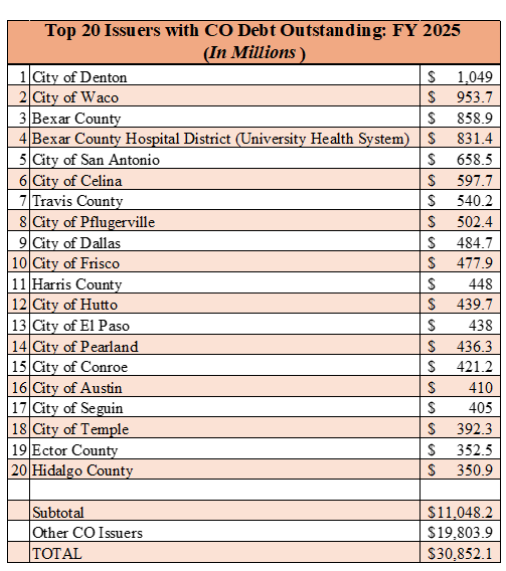
Per the report, CO debt outstanding increased “from $13.24 billion outstanding in fiscal year 2016 to $30.85 billion outstanding in fiscal year 2025.” Of this amount, the top 20 highest users accounted for more than 35% of all CO debt outstanding. As seen below, those users included a mix of city governments (14), county governments (5), and one hospital district.
Surprisingly, the governmental entity most reliant on nonvoter-approved debt—i.e., the city of Denton—owed more than $1 billion in CO debt. Three other entities—i.e., the city of Waco, Bexar County, and the Bexar County hospital district—appear within striking distance of the $1 billion debt mark.
Needless to say, this is an enormous amount of public debt to consume without voter approval and it adds further urgency to the conversation around reform.
So take a look—did your local government make the list of those least likely to ask voters for permission to go into debt and raise taxes?