U.S. Immigration and Customs Enforcement (ICE) recently reported a landmark milestone: the 287(g) program now has over 2,500 active Memorandums of Agreement covering 39 states and two U.S. territories. These agreements authorize ICE “to delegate state and local law enforcement officers the authority to perform specified immigration officer functions under ICE’s direction and oversight.”
This explosive expansion (up from 1,000 agreements just a year ago) is a harsh rebuke of the Biden administration’s devastating open-border policies. Local governments across the country are recognizing that state and federal cooperation is essential to restoring public safety and the rule of law.
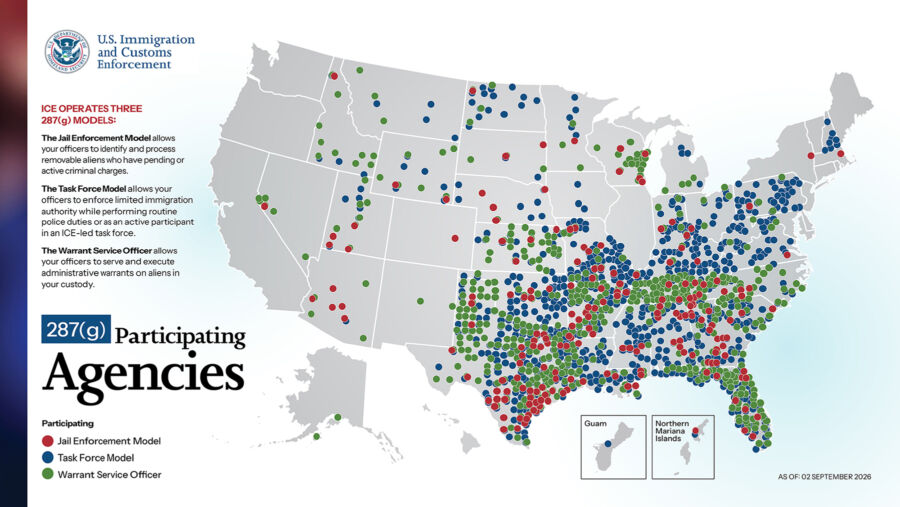
Yet a stark divide persists. While liberal states sacrifice public safety on the altar of “sanctuary” policies (looking at you, California), more conservative states are proving why these partnerships work. The 287(g) program serves as a vital force multiplier for law enforcement by empowering local officers to identify, process, and hold criminal illegal aliens already in custody. Instead of releasing dangerous offenders back onto the street, officers can ensure they are handed over for removal.
You can see from the map above that Texas has a sizable number of 287(g) participants. However, there are still plenty of holdouts creating dangerous gaps. A patchwork approach is no defense at all against sophisticated cartel networks.
Texas has stepped up in the past to fill the void from federal inaction. When the Biden administration abdicated its responsibility to defend our southern border, Texas responded by launching Operation Lone Star. The Texas Legislature has taken steps in recent sessions to strengthen immigration enforcement statewide and assert state sovereignty. But voluntary, piecemeal 287(g) participation among local jurisdictions leads to soft spots that can be exploited by bad actors.
Reclaiming control over our safety requires bold, uniform action. The Texas Legislature should take the next logical step of requiring all Texas law enforcement agencies to participate in the 287(g) program. By mandating full participation across every sheriff’s office, police department, and constable, Texas can build an airtight enforcement network that will make our communities safer.
This commentary is published on Thursdays as part of TPPF’s subscriber-only newsletter that rounds up content from the week. Subscribe to The Post >>