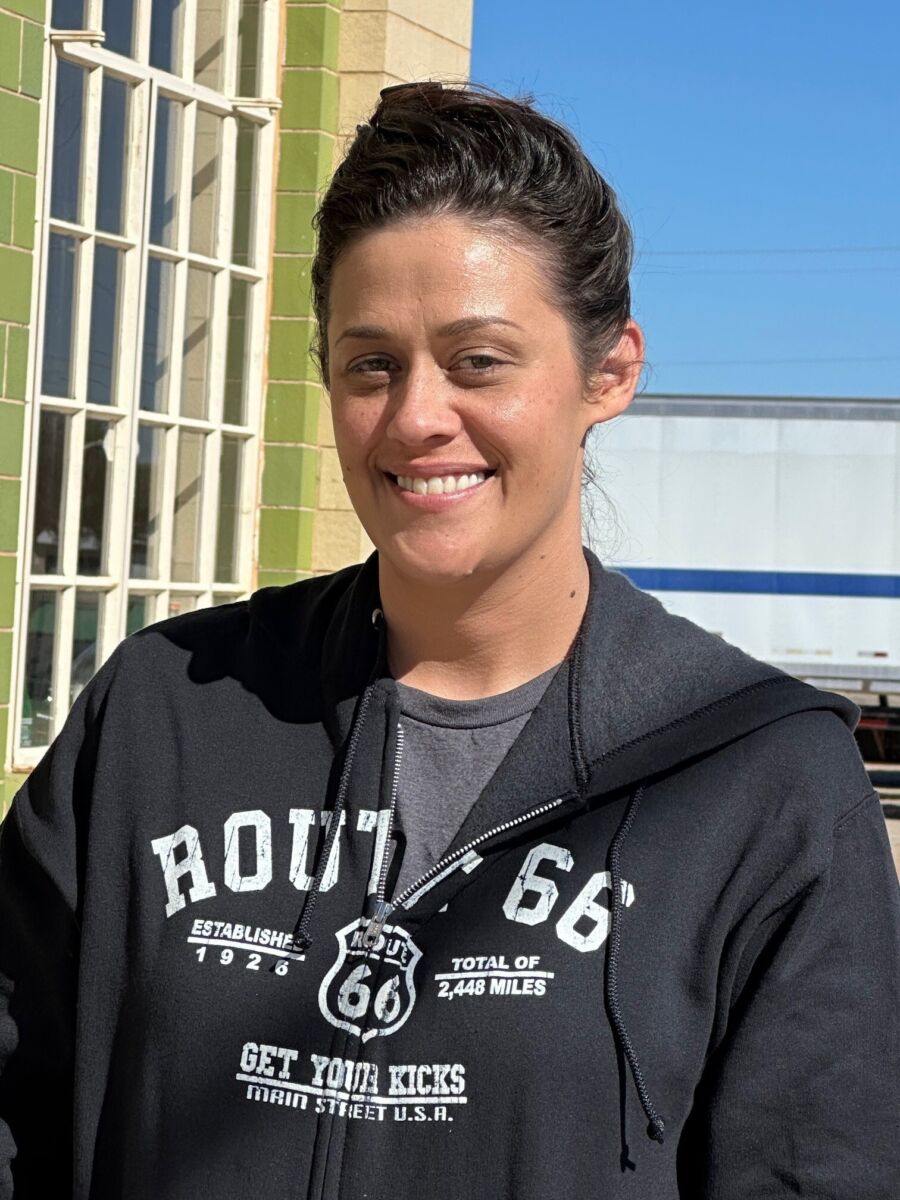
Family, then finances—and opportunity. Those are what brought Lianne Halpern back to tiny Shamrock, a small, dusty stop on the famous Route 66 in the Texas panhandle.
Like generations of Americans before, Lianne and her family had traveled west along that route in search of the golden promises of California. Lianne’s father worked in the oil fields near Bakersfield, where he raised his family. But California wasn’t home, she felt. When her father returned to Texas, she knew she wanted to follow him home.
“My dad and my grandmother—she’s really like a mother to me—are here,” Lianne said. “My grandmother is 82, so we wanted to be here, with her and for her. And I can’t express how much joy that has brought us.”
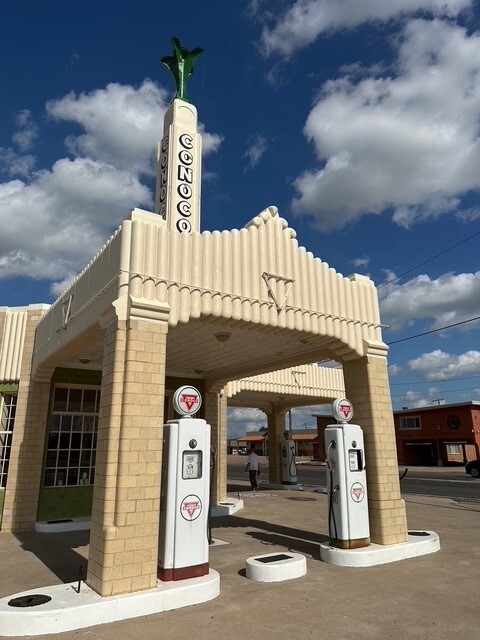
Ultimately, it was her grandmother who let Lianne and her husband, Aldo, know that the city of Shamrock was looking for someone to operate a diner in the historic Conoco station, an iconic Route 66 stop. Lianne, a California-trained chef, thought it sounded perfect.
What Lianne learned about rural Texas is that opportunities abound—if you keep an open mind and a willingness to work hard. Little comes easily in the Texas Panhandle, but that’s always been true. And like generations of Texans before her, Lianne had the grit and gumption to pursue her dreams in this starkly beautiful landscape.
“We knew what we wanted in our hearts—we wanted to make a move here,” Lianne explained. “We wanted to open some kind of a business. We wanted it to be food-related and community-focused.”
Lianne’s grandmother, who served on the county historical commission, put her in touch with the city’s economic development office, and they quickly came to an agreement. Lianne opened the U-Drop Inn Café, with classic American fare seasoned with a little California cuisine.
“We liked the idea of continuing my family’s legacy of preserving the history of this area,” she said. “What these communities need are people who care, who are rooted in them, to lift up these places and continue to invest in them. These places matter.”
A Rich History
The U-Drop Inn, a diner in the restored Conoco Tower building in Shamrock is a rare, well-preserved example of an Art Deco gas station. It was built in 1936 to service what John Steinbeck called the Mother Road. In hopes that Route 66 would lead to an economic boom, its builder, J.M. Tindall brought in famed architect J.C. Berry to design a towering beacon for tired travelers. He even added a dance hall.
“This was an important stop,” Lianne said. “When the station was built, about 5,000 people lived here. It was the first stop in Texas on Route 66 for travelers going west.”
A cardboard cutout of Elvis and a plaque commemorate the time in 1963 when the King himself stayed at the nearby Sun ’n Sand Motel (now the Route 66 Inn) and ate in the corner booth at the U-Drop.
Its green neon lights beaconed travelers and tourists until I-40 came through. It fell into disrepair in the 1990s, and now the city of Shamrock owns it, while Lianne’s family leases the restaurant portion. The dance hall is now the Shamrock Visitor’s Center, and bands are sometimes booked for special events.
But that’s not the inn’s real claim to fame now, or why so many families seek it out. In 2006, the animated movie “Cars” used real Route 66 locations as its models, and the U-Drop Inn was cast in the role of Ramone’s paint and body shop in Radiator Springs. “Cars” connected whole new generations to Route 66.
Lianne loves the small-town life, and the lifeline Route 66 provides. The Mother Road still sustains industry and commerce, just as it has since it was established.
And she returns the favor. Her culinary education and market research into the Route 66 clientele led her to keep the menu simple.
“What I found is that people want American food, comfort food, on their Route 66 trip,” she said. “They want authentic. They want Grandma’s meatloaf. So that’s exactly what’s on our menu — my grandmother Ava’s meatloaf.”
Lianne has preserved the lunch counter in the U-Drop Inn. That’s because she loves the direct interaction she has with travelers at the lunch counter when they stop in. “They want to know everything,” she said. “They’re just so happy to be here.”
There’s something about Route 66 that rises above the everyday and even the political. People get along here because they’ve come to connect to something bigger. People don’t visit Route 66 to change America; they come to be changed by it.
“No matter where they’re from, they have a passion for America,” Lianne said. “And this is America, distilled.”
Opportunity
In California, Lianne said, her options felt limited. And so did her financial future.
“When COVID-19 hit, we were in the big city of Los Angeles,” she said. “That’s when we really began to understand that we were being priced out of being in the city. We were in our 30s, and we realized we would never have enough saved to buy a home there. For our generation, it just seems like so many chips are stacked against us. It just wasn’t sustainable for us.”
The couple moved to Mesa, Arizona, but they quickly realized that wasn’t far enough. They soon came all the way back to Texas.
“We moved to Texas to get out of the heat,” she said.
Lianne and Aldo were able to purchase their first home on a little bit of land with a 15-year mortgage they could live with.
“Being close to family was important,” she said. “Where do you put down roots? Where you’re needed. And this is where we were needed.”
Now, she says, she has it all—family close by, the historical connections that she loves, and a bright future as part of something bigger: a community.
“Between Shamrock and Canadian and Wheeler, there’s plenty going on,” she said. “There’s always football and other sports, and we have nieces and nephews who are always doing something. There are restaurants in Shamrock, there’s a historic movie theater that shows movies.”
Being in rural Texas doesn’t mean being disconnected from the larger world.
“What my husband and I would really like to see is more young people moving to rural towns,” she said. “There’s a common misconception that there’s no opportunities here, because the communities are small and isolated. But that’s exactly why there is so much opportunity—these areas are underserviced. They need electricians, plumbers, health care workers, IT workers, and the list goes on. If you have a little entrepreneurial spirit, there’s a lot to be had out here.”
Editor’s note: Portions of this interview were previously published here and here.
Read more: Strength and Struggle in Rural Texas